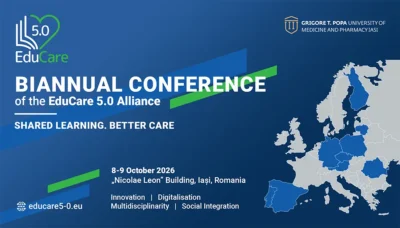
UMF Iași hosts the EduCare 5.0 conference on 7–11 October 2026. The agenda includes digital oncology and healthcare innovation projects.
National project to train 966 ICU professionals and improve critical care

Adaugă Medic24 în sursele preferate Google
The INTENSIV+ project will train 966 ICU professionals and develop national curricula, medical simulation scenarios, and a critical care guideline.
A national training program dedicated to critical care will train 966 professionals in anesthesiology and intensive care and introduce standardized curricula for ICU nurses and extracorporeal circulation specialists. The INTENSIV+ project will run until the end of 2028 and includes simulation-based training and clinical placements in seven university centers across Romania.
The Romanian Society of Anesthesia and Intensive Care is a partner in the INTENSIV+ – Developing ICU Capacity for Critical Care project, SMIS code 352313, implemented by the “Prof. Dr. C.C. Iliescu” Emergency Institute for Cardiovascular Diseases. The third partner is the Romanian Order of Nurses, Midwives and Medical Assistants (OAMGMAMR).
The project started on March 25, 2026 and will run until December 2028. It is co-financed by the European Union through the European Social Fund Plus, under the Health Programme.
National curriculum for ICU nurses
One of the main components of the project is the development of a national training curriculum for nurses working in anesthesiology and intensive care units.
The objective is to create a standardized professional training framework so that the competencies required for the care of critically ill patients are developed according to common standards and subsequently transferred into clinical practice.
According to SRATI, the project aims both to standardize professional training and to improve the quality and safety of care provided to critically ill patients.
Separate training program for ECLS and ECMO specialists
INTENSIV+ will also develop a national curriculum for extracorporeal circulation specialists, including professionals involved in ECLS/ECMO techniques.
ECMO – extracorporeal membrane oxygenation – is an advanced form of temporary cardiac and/or respiratory support used in selected critically ill patients. Running such programs requires multidisciplinary teams with specific training and experience in the management of patients with severe organ failure.
SRATI has previously developed initiatives dedicated to training professionals in extracorporeal circulation, including educational programs aimed at obtaining European certifications.
National simulation scenarios for critical situations
Another component of the project is the development of a national set of medical simulation scenarios for interventions in critical situations.
Simulation allows healthcare teams to practice the management of complex situations in a controlled environment, without putting patients at risk, and can be used to develop both technical skills and competencies related to teamwork, communication and rapid decision-making.
SRATI has already used this training method in other professional education projects. The Society identifies medical simulation as an important component in the training of teams involved in anesthesia, intensive care and emergency management.
A national guideline for critical care will be developed
The project also includes the development of a national best-practice guideline for the care of critically ill patients in intensive care units.
The document is intended to complement the training tools developed within the project and contribute to the standardization of professional practices across participating healthcare facilities.
Overall, INTENSIV+ will produce two national training curricula, a national set of simulation scenarios and a best-practice guideline dedicated to critical care.
966 professionals will take part in the program
The national training program will include 966 professionals and will combine online theoretical education with practical activities.
The practical component will include medical simulation sessions and clinical placements organized in university centers in Bucharest, Iași, Cluj, Craiova, Târgu Mureș, Sibiu and Timișoara.
Through this structure, the project aims not only to provide theoretical knowledge but also to develop the competencies required to intervene in critical clinical situations.
Objective: a standardized national framework for ICU training
According to SRATI, the overall objective of INTENSIV+ is to increase access to and effectiveness of services provided to critically ill patients by developing standardized professional training tools and applying the acquired competencies in clinical practice.
The project therefore addresses one of the essential components of intensive care unit performance: the training and coordination of teams caring for patients with severe and unstable conditions who require a high level of monitoring and support of vital functions.
Through INTENSIV+, SRATI aims to contribute to bringing professional ICU training closer to international standards and to developing a more consistent training system for healthcare professionals involved in critical care.
Medic24 - Romania's healthcare system at a glance

Fundeni reports a living-donor liver transplant with robotic graft retrieval. Both the donor and recipient are recovering favourably.
CNAS and STS have launched a European project for the cross-border exchange of medical images, laboratory results and discharge reports by 2029.

The INTENSIV+ project will train 966 ICU professionals and develop national curricula, medical simulation scenarios, and a critical care guideline.

Nearly 3 in 10 births in Romania in 2025 occurred without prenatal care. Among mothers under 15, the proportion exceeded 43%.

Romania spent €12.2 per capita on prevention in 2023, the lowest level in the EU. Comparison based on Eurostat and OECD data.