
Romania’s 2026 residency exam offers 645 Family Medicine places. See the allocation by university centre and the registration deadline for the 15 November exam.
Five complex cardiac ablation procedures performed over two days at SCJU Bihor
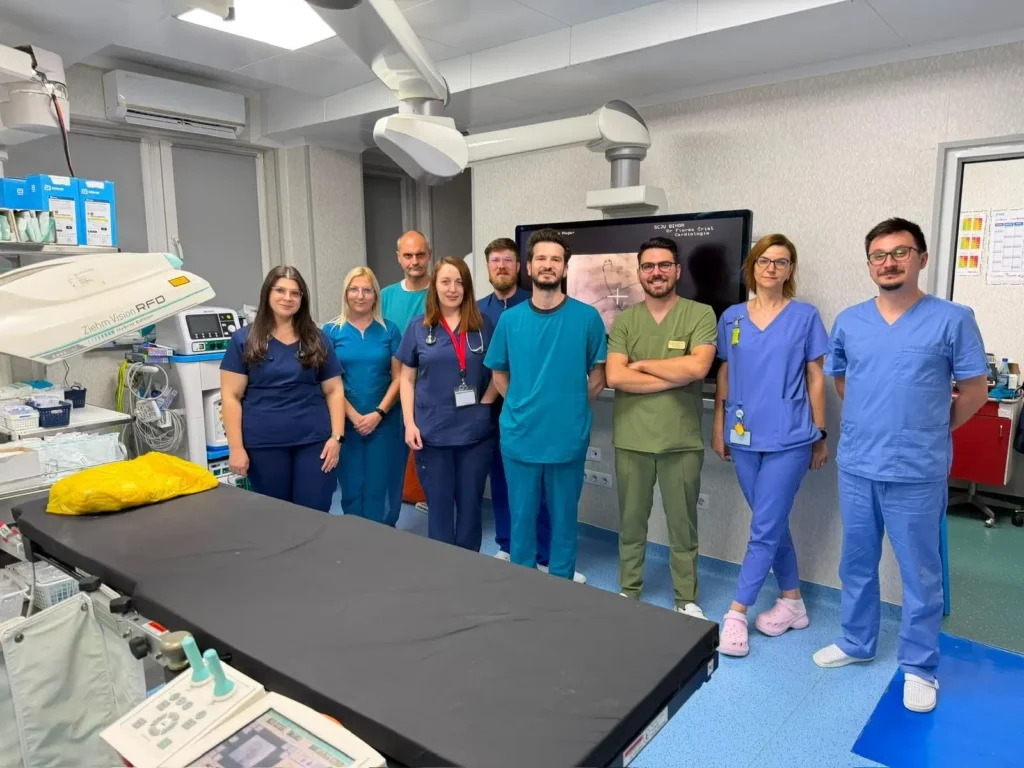
Foto: SCJU Bihor
Adaugă Medic24 în sursele preferate Google
SCJU Bihor performed five complex cardiac ablation procedures, including treatments for atrial fibrillation and Wolff-Parkinson-White syndrome.
A multidisciplinary team at the Bihor County Clinical Emergency Hospital performed five complex cardiac ablation procedures on August 5–6, 2026. Four of the interventions were carried out to treat atrial fibrillation, while one involved a patient with Wolff-Parkinson-White syndrome. The procedures used three-dimensional cardiac mapping systems, according to a statement issued by the hospital.
The four procedures performed in patients with atrial fibrillation involved three-dimensional reconstruction of the left atrium and pulmonary veins, allowing cardiac anatomy to be correlated with electrical activity and helping physicians identify the areas involved in generating the arrhythmia.
3D mapping for atrial fibrillation ablation
Atrial fibrillation is the most common sustained cardiac arrhythmia and is characterized by disorganized electrical activity in the atria. In addition to symptoms such as palpitations, shortness of breath or fatigue, the condition is associated with an increased risk of stroke.
During the procedures performed at SCJU Bihor, physicians used catheters introduced through the venous system and advanced to the heart. Interventions involving the left atrium require passage through the interatrial septum, with the procedure performed under imaging guidance.
The mapping system records a large number of electrical signals and allows physicians to construct an individualized three-dimensional map of the heart. This map can be used to identify the areas involved in triggering or maintaining the arrhythmia, which can then be targeted with ablation energy.
In atrial fibrillation, one of the main targets of the procedure is the electrical isolation of the pulmonary veins. At the end of the intervention, electrophysiological testing is performed to assess the outcome of the ablation.
The four patients treated for atrial fibrillation were between 50 and 60 years old.
Ablation in a 27-year-old patient with Wolff-Parkinson-White syndrome
The fifth case involved a 27-year-old patient diagnosed with Wolff-Parkinson-White (WPW) syndrome.
In this condition, an accessory electrical pathway exists between the atria and ventricles, which can allow abnormal conduction of electrical impulses and lead to tachyarrhythmias. In certain situations, particularly when atrial fibrillation is conducted very rapidly to the ventricles through the accessory pathway, severe ventricular arrhythmias may occur.
In the case treated in Oradea, the accessory pathway was located on the left side, and the patient also experienced episodes of atrial fibrillation. The medical team identified the abnormal pathway and performed its ablation.
According to SCJU Bihor, all five procedures were completed successfully and the patients were subsequently discharged.
Multidisciplinary team involved in the electrophysiology procedures
The interventions required collaboration between cardiologists, intensive care physicians, nurses and engineers providing technical support for the electroanatomical mapping systems.
The team was led by Dr. Cristian Florea, consultant cardiologist with expertise in interventional cardiac electrophysiology, with the participation of Associate Professor Dr. Radu Roșu, consultant cardiologist from Cluj-Napoca, Dr. Diana Opincariu, consultant cardiologist with expertise in transesophageal echocardiography, and Dr. Mirel Fanya, cardiology resident.
The intensive care team included Dr. Ștefania Sije, consultant in anaesthesia and intensive care, and Dr. Andreea Toma, specialist in anaesthesia and intensive care. Technical support was provided by engineers Bogdan Cireașă and George Bogdan Popovici, while the nursing team included Ioana Carțiș, Diana Moldovan, Melinda Chirodea and Beatrice Duma.
The procedures were performed in the Angiography and Cardiac Catheterization Laboratory of SCJU Bihor, coordinated by Dr. Virgil Popa, consultant cardiologist.
Procedures funded through the National Cardiovascular Disease Programme
According to the hospital, the procedures require specialized electrophysiology catheters and other consumables, with the catheter set used for a single intervention costing approximately RON 29,000 excluding VAT.
The materials needed to initiate these procedures were initially purchased from the hospital’s own funds, while subsequent funding was secured through the National Cardiovascular Disease Programme.
The development of these interventions expands the hospital’s capacity to treat locally patients with arrhythmias who require interventional cardiac electrophysiology procedures and three-dimensional electroanatomical mapping.
Medic24 - Romania's healthcare system at a glance
UMF Iași hosts the EduCare 5.0 conference on 7–11 October 2026. The agenda includes digital oncology and healthcare innovation projects.

Fundeni reports a living-donor liver transplant with robotic graft retrieval. Both the donor and recipient are recovering favourably.
CNAS and STS have launched a European project for the cross-border exchange of medical images, laboratory results and discharge reports by 2029.

The INTENSIV+ project will train 966 ICU professionals and develop national curricula, medical simulation scenarios, and a critical care guideline.

Nearly 3 in 10 births in Romania in 2025 occurred without prenatal care. Among mothers under 15, the proportion exceeded 43%.